
How to Maintain Icy Blonde Hair at Home: 2026 Guide
Table of Contents
Why Icy Blonde Hair Fades (and What You Can Do About It)
Your Weekly Icy Blonde Hair Maintenance Routine
Wash Day: Sulfate-Free Products and Cool Water
Deep Conditioning and Protein Treatments
How to Fix Brassy Blonde Hair at Home
Best Purple Shampoo for Icy Blonde: What to Look For
Budget vs. Luxury: Where the Money Actually Goes
How to Prevent Hair Breakage After Bleaching
Water Quality, Seasonal Shifts, and Product Tiers
How Water Quality Affects Icy Blonde
Seasonal Maintenance Adjustments
Frequently Asked Questions
Last Updated: September 23, 2026
Why Icy Blonde Hair Fades (and What You Can Do About It)
Icy blonde hair is a cool, near-white shade at the lightest end of the blonde spectrum, and the most fragile color you can wear. That fragility is chemistry, not styling: bleaching leaves the cuticle more porous, and porous hair releases toner faster than healthy hair holds it. Understanding why icy blonde hair fades is the first step toward slowing it down.
Oxidation and UV exposure break down the cool violet and blue pigments in your toner, pushing the shade toward yellow and orange.
Water and heat open the hair cuticle, letting color molecules escape with every wash and blow-dry.
Porosity determines how fast all of this happens. High-porosity hair from bleaching grabs toner quickly but loses it just as fast.
Your Weekly Icy Blonde Hair Maintenance Routine
A workable at-home routine for icy blonde hair runs on a simple weekly rhythm: one wash day with sulfate-free products, one deep conditioning or protein treatment, and purple pigment used only when brassiness appears. Most people overwash and over-tone; both strip the cuticle and shorten the life of your color.
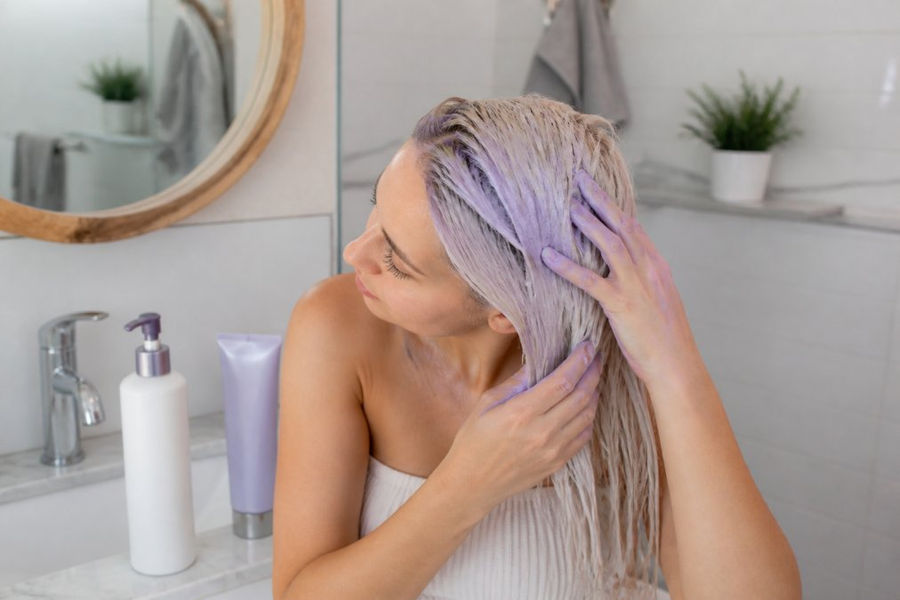
Wash Day: Sulfate-Free Products and Cool Water
Wash your icy blonde hair no more than twice a week, and use cool water every time. Hot water swells the cuticle and flushes toner out faster, which is why clients who shower hot lose their cool tone first. Sulfate-free shampoo matters because sulfates strip both natural oils and deposited color.
The order of operations on wash day:
Rinse with cool water for 30 seconds before shampooing to loosen buildup.
Apply sulfate-free shampoo only to the scalp, letting runoff clean the mid-lengths and ends.
Follow with a color-safe conditioner from mid-length to tips, and leave it for two to three minutes.
Finish with a cool rinse to seal the hair cuticle before styling.
Apply a heat protectant if you plan to blow-dry or flat-iron.
Deep Conditioning and Protein Treatments
Deep conditioning restores moisture balance; protein treatments rebuild structure. Icy blonde hair usually needs both, but not on the same day and not in the same week if your hair is already fragile. A common mistake is treating every problem with protein. Overuse causes stiffness and snapping, the opposite of what damaged hair needs.
A practical split for most people:
Week 1: deep conditioning mask, 20 minutes under a shower cap.
Week 2: protein treatment, following the package timing exactly.
Week 3: deep conditioning mask again.
Week 4: assess. If hair feels elastic and soft, continue the rotation. If it feels brittle, skip protein and add moisture.
How to Fix Brassy Blonde Hair at Home
Watch Out Leaving purple shampoo on for 20 minutes "to make it work faster" is the single most common cause of gray, dull blonde we see. Follow the label timing, usually one to three minutes, and reapply next wash if you need more.
If your hair has been toned repeatedly and still looks muddy, the issue is likely porosity rather than pigment. Very porous hair grabs toner unevenly, which is why a professional toning service often produces a cleaner result than home products alone.
glamazontay
Best Purple Shampoo for Icy Blonde: What to Look For
The best purple shampoo for icy blonde hair has a cool violet base, no sulfates, and a pH balanced for color-treated hair. But the front label tells you almost nothing about how the formula behaves on porous, bleached hair. What matters is inside: the pigment load, the surfactant system, the pH, and whether the formula offsets the drying effect of repeated toning.
Feature | What to Look For | Why It Matters |
Pigment tone | Violet (D&C Violet No. 2 or CI 60730) for yellow; blue-violet or a violet-blue blend for orange | Neutralizes the correct undertone instead of adding an unwanted cast |
Pigment load | Higher concentration means shorter dwell time; lower concentration means you can leave it on longer without over-toning | Controls how forgiving the product is for at-home use |
Surfactants | Sulfate-free (look for sodium cocoyl isethionate, cocamidopropyl betaine, or glucosides) | Slows color fading and is gentler on a compromised cuticle |
pH balance | Slightly acidic, roughly 4.5 to 5.5 | Keeps the hair cuticle closed so pigment stays deposited longer |
Extras | Bond-building agents (bis-aminopropyl diglycol dimaleate), hydrolyzed proteins, or humectants like glycerin | Reduces the dryness that repeated toning causes |
Format | Color-depositing mask or conditioner vs. shampoo | Masks give more control because you can watch pigment develop; shampoos are faster but easier to overdo |
Budget vs. Luxury: Where the Money Actually Goes
You do not need a luxury shelf to maintain icy blonde hair, but the price tiers do not deliver the same thing. The difference is usually not the pigment, violet is violet, but the supporting formula around it.
Budget tier (drugstore and mass-market): These formulas typically rely on a single pigment and a basic surfactant system. They can work well if the pigment is strong and the formula is sulfate-free, but they often skip bond-builders and humectants, so they dry the hair more with each use. If you tone once a week or less, a budget option is usually fine.
Mid-range tier (salon-adjacent and professional retail): These formulas usually add conditioning agents, a slightly more acidic pH, and sometimes a second pigment for a more nuanced tone. This is where most people find the best balance of results and cost.
Luxury tier (prestige and bond-building brands): The premium is mostly for bond-building ingredients and gentler surfactant systems. For platinum and ash blonde shades that have been bleached multiple times, that gentleness matters more than it does for a darker blonde who tones occasionally. For a single-process blonde with healthy hair, the extra cost rarely translates to a visible difference.
Pro Tip If you are choosing between two purple shampoos at different price points, compare the pigment concentration and the surfactant list first. A higher pigment load lets you use less product per wash, which often closes the price gap over time.
How to Prevent Hair Breakage After Bleaching
Preventing hair breakage after bleaching comes down to reducing mechanical and thermal stress while the cuticle recovers, which can take several weeks. Bleach damage is cumulative: each lightening session removes more internal structure, and once the protein bonds are compromised, they do not fully rebuild on their own.
The measures that make the biggest difference:
Heat protectant, every time. Never apply a flat iron or curling wand to damp, unprotected hair.
Lower your heat settings. Medium heat with multiple passes damages less than one pass on high.
Bond-building treatments. These help reinforce the hair's internal structure between appointments.
Loose styles and silk pillowcases. Friction at the root causes breakage near the scalp, where new growth is weakest.
Regular trims. Splitting ends travel upward; trimming every six to eight weeks stops the damage from spreading.
Pro Tip Apply bond-building treatment to damp hair before your purple shampoo, not after. The treatment fills gaps in the cuticle so the toner deposits more evenly and fades slower.
Water Quality, Seasonal Shifts, and Product Tiers
Two factors most at-home guides skip are water quality and the seasons, and both change how your icy blonde hair behaves more than most people realize. If your toner fades faster than your friends' does, or your color looks dull no matter how often you tone, your shower water is a likely culprit.
How Water Quality Affects Icy Blonde
Municipal water in most of the country carries dissolved minerals, primarily calcium and magnesium, plus chlorine or chloramine. On bleached, porous hair, those minerals deposit on the cuticle as a chalky film that dulls the cool tone and compete with toner molecules for the same binding sites, so less pigment sticks. Chlorine and chloramine also oxidize the violet and blue pigments in your toner, pushing the shade toward yellow even between washes.
Signs your water is working against you:
A chalky or filmy feel on hair even after a fresh wash
Toner that looks right for one wash and then fades within days
White or gray residue on showerheads and glass doors
Hair that feels squeaky rather than soft after conditioning
What helps:
A shower filter. Carbon and KDF filters reduce chlorine and chloramine; some also reduce sediment. They are a low-cost, low-effort way to cut mineral and oxidizer exposure over time. Replace the cartridge on the manufacturer's schedule, a spent filter does nothing.
A chelating or clarifying treatment once a month. Chelating shampoos bind to metal ions and lift them off the hair; clarifying shampoos remove product and mineral buildup. Follow either with a deep conditioning mask, because both strip moisture along with buildup.
A final cool-water rinse. Cool water closes the cuticle and helps the toner stay put; hot water does the opposite.
Seasonal Maintenance Adjustments
Icy blonde behaves differently in summer and winter, and the routine that works in one season can fail in the other. Adjusting for the seasons is one of the most overlooked parts of at-home maintenance.
Summer (UV and sweat):
UV exposure breaks down toner pigments directly. UV protection sprays, hats, and keeping hair covered during peak sun hours slow the fade.
Sweat and increased washing both strip toner. Rinse with cool water after swimming or heavy sweating, and use a leave-in conditioner with UV filters.
You may need to tone slightly more often, but resist the urge to increase dwell time, increase frequency instead.
Chlorine and salt water are both hard on porous hair. Wet hair with fresh water and apply a leave-in before swimming to reduce absorption.
Winter (dry indoor air and static):
Indoor heating drops humidity, which pulls moisture from porous hair and makes it feel brittle and prone to static.
Switch to a heavier conditioning mask and consider a leave-in or hair oil on ends.
Wash less often, every three to four days instead of every two, because dry hair is more fragile and less able to hold toner evenly.
Static and friction cause breakage near the scalp, so loose styles and silk pillowcases matter more in winter.
The single biggest predictor of how long your icy blonde lasts is not the product brand. It is how often you wash, how hot your water runs, what is in your water, and whether you protect your hair from heat and UV.
Frequently Asked Questions
How often should I use purple shampoo on icy blonde hair?
Most stylists recommend using purple shampoo once or twice a week, depending on how quickly your icy blonde hair develops yellow undertones. If your hair is very porous or you wash frequently, you may need it more often. Overuse can leave a violet cast, so start with once a week and adjust. Alternate with a sulfate-free moisturizing shampoo to keep hair hydration balanced.
What is the hardest hair color to maintain?
Icy blonde and platinum blonde are among the hardest colors to maintain because they require regular toning, sulfate-free care, and protection from heat and UV exposure. Color fading and brassiness appear quickly, especially without a consistent maintenance routine. Expect root touch-ups every four to six weeks and toning every two to three weeks to keep the cool-toned finish.
Is icy blonde the same as platinum blonde?
Icy blonde and platinum blonde are closely related but not identical. Platinum blonde is the lightest level, almost white, while icy blonde has a cool, slightly blue or silver undertone that gives it a frosty appearance. Both require similar maintenance, including purple shampoo, bond-building treatments, and regular toning to prevent yellow undertones from developing.
How do I keep my blonde hair from turning yellow?
Keep brassiness away by washing with cool water, using a sulfate-free shampoo, and incorporating a purple or color-depositing mask into your routine. Limit heat styling and always apply a heat protectant. UV protection matters too, so wear a hat or use a UV spray when outdoors. If yellow undertones persist, a professional toning session resets the color.
Get Started Today
Comments